

Stop Moving.
A lesson from the Amazon

(Written on July 14, 2026…)
It’s 7 pm in Lima, Peru.
I’m on the patio of La Panchita, a local restaurant recommended by a local, three minutes from my hotel.
A guy has been laying on his horn for literally one whole minute. Wild.
The city. I’m back in the city. The undeniable bustle, the running around.
I miss the jungle. I didn’t think I would. I thought I’d be thrilled to be going back to Barcelona.
A quick recap: I’m a huge fan of Junglekeepers, an organization that is working to protect 300,000+ acres of the most biodiverse land on Earth in the Madre De Dios region of the Amazon rainforest. I connected with them, they invited me down, and I just spent a week in the jungle.
This trip, like all trips, didn’t meet my expectations.
Instead of a solo spiritual experience, I was surrounded by indigenous guides and a few foreign visitors.
Instead of meeting Paul Rosolie, the founder, I met his director and his team. Instead of coming out satiated, I’ve left emboldened.
The land I’m coming back from is precious and I don’t say that lightly. Whoever came up with the Garden of Eden in the Old Testament must have somehow spent time in Madre De Dios, aka Mother of God.
It is so raw, so untouched. No wonder they’re risking their lives to protect it.
It used to take two days by boat from the nearest city, Puerto Maldonado, to get there. Now it takes a few hours via car and boat. Someone cut a road through the jungle forty minutes upriver and a new town has popped up there since, and with it logging.
Logging, gold mining and agriculture: the three headed monster of rainforest destruction.
You’d think the Junglekeepers team would hate the guys with chainsaws but they don’t. Most of the guides were once loggers. They understand that poverty incentivizes short-term decisions over future preservation.
Their real enemy is time. Because the urgency is clear: if they can’t buy and protect this land within the next few years, it will be gone.
But why should I care and why should you?
I have friends telling me they love what I’m doing but that the Amazon isn’t really their thing, their cause. And I’m sure there’s a lot of you reading this that feel that too.
I could give you all the data points to convince you that this is important: the absurd amount of carbon the Amazon captures, the 20% of global oxygen it produces, the infinite number of species it hosts, the last of the uncontacted tribes it protects.
But after going there and seeing it for myself, I don’t think those points fully capture its importance.
Instead, I’m going to share a quick story with you…
The first three days I walked through the jungle, I saw one monkey.
I couldn’t believe it.
I had come all this way, and heard all this talk about wildlife, and all I saw were bullet ants and birds.
Halfway through my stay, I shared my frustration with Stephane, the director of Junglekeepers. He understood the problem right away: silence. You have to be silent. “These animals have evolved millions of years to hide. So, the next time you go out there,” he said, “just stop moving. Wait and see what happens.”
The next day I went out into the woods alone.
I walked slowly, observing, trying to channel my hunter gatherer ancestors and…nothing. Still freaking nothing.
And then, I listened to Stephane’s advice: I stopped in my tracks, closed my eyes and took a deep breath. Be still Matt, be still.
And I swear on everything I love, as soon as I opened my eyes, through the hole in the trees I saw a howler monkey staring back at me.
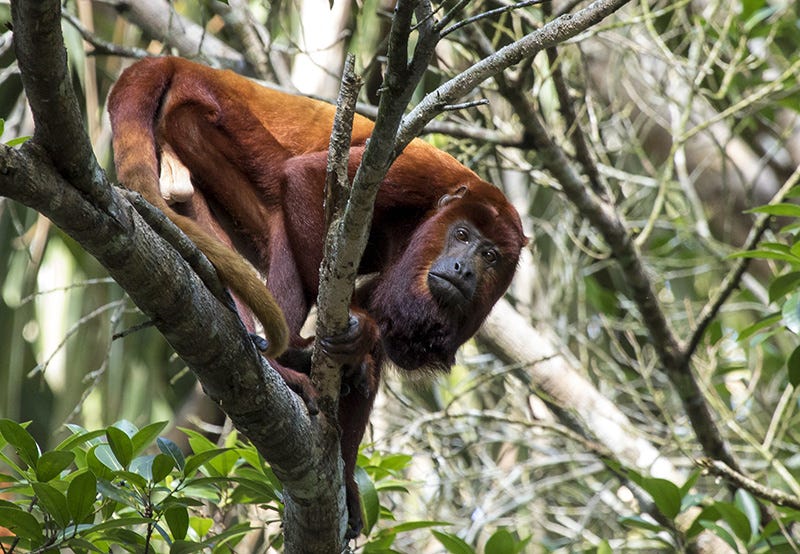
His head was tilted, observing me.
I didn’t move a muscle.
Soon enough, he began crawling across branches, picking at leaves, scratching his butt, dropping two huge poops. I’ve never felt more touched watching another animal relieve themselves.
It was such a sudden, intimate look at life.
Within that next hour I got to partake in a world far removed from the one I grew up in. Spider monkeys, howler monkeys, families of squirrel monkeys, suddenly started flying around.
Some noticed me, others ignored me, one started shaking the branch at me to establish dominance. I felt like I was home.
I finally felt like an animal.
When I got back to camp, I excitedly shared with the local guides: You have no idea what I saw! Probably forty of them! It was crazy! I felt so ALIVE!
They each smiled at me like, yeah buddy, welcome to our lives. Why do you think we’re doing this work?
It was that day that I finally understood that protecting the wild isn’t about statistics, facts or pages of research.
It’s about protecting a part of ourselves that we’ve forgotten.
It’s about protecting the version of us that gnaws at us when we spend too much time in front of a screen or inside a cubicle.
It’s about protecting our truth. Our deep, undeniable, raw, animalistic truth, that we try to keep at bay in order to be civilized, sanitized and in control.
Being back in the “modern” world now, I’m more motivated than ever to help protect that world I got to be part of.
Junglekeepers are in the process of buying 2,500 acres to protect it forever, and I want to help them do it with my own money and with my community. If you’re willing to join me, I’ll share exactly how soon.
For now, here’s a video from my last day there.
A group of squirrel monkeys and howler monkeys, right outside camp.
They send their hellos :)
Love,
Matt, aka Indian Jones Jr.
I’ve lived here in Peru for 13 years. It’s a special place with so much wisdom. To stay still. To slow down. Is such a powerful thing. It’s one thing to know it. It’s another thing to do it. I spent 3 years deep in the jungles of Machu Picchu off grid. The magic I left with is beyond words. Thanks for sharing this with your audience. Thank you for being still to be one with the mama
"I finally felt like an animal." Just... Wow!